- Warehouse Wisdom. Weekly.
- Posts
- Warehouse Wisdom, Weekly. 12/12/2025
Warehouse Wisdom, Weekly. 12/12/2025
Only the most relevant news for SMBs to improve logistics – picked, packed, and delivered without the bias.

Will Schneider
December 12, 2025
In partnership with


🚚 Happy Friday.
Amazon and USPS negotiations collapsed with no deal reached, ending a partnership generating $6 billion annually. Union Pacific and Norfolk Southern approved an $85 billion rail merger promising 20% faster transit just as trucking rates crashed low enough to beat intermodal on price. And 95% of U.S. industrial businesses plan automation within three years, but 48% cite high capital costs as the barrier. Your biggest customer builds competing infrastructure, rail invests in speed nobody can afford, and robots require checks most operators can't write. Ready to jump in?
Global Logistics
Water treaties meet tariff threats while Europe exits China

The White House threatened 5% tariffs on Mexican imports over alleged water treaty violations, demanding Mexico release 200,000 acre-feet by year-end or face additional levies on top of existing 25% tariffs. The threat arrives as USMCA review approaches next summer, with current tariffs requiring constant exemption renewals to function.
European firms accelerated supply chain exits from China as Beijing's export controls and 37 consecutive months of factory gate deflation reshape trade flows. China's trade surplus topped $1 trillion. The EU's container trade imbalance with China widened from 1:2.7 in 2019 to 1:4 today. Sectoral splits reveal complexity: 80% of pharmaceutical firms localize deeper into China while 33% of IT companies build alternatives elsewhere, but one in five firms still imports critical components with zero alternatives available.
Lineage projects $110 million in annual EBITDA gains from warehouse automation rollout through 2029, with LinOS reaching 250 locations handling 30% of U.S. calories consumed. High-reach pilots produced 30% improvements in hourly movements and 5% labor reductions per pallet. The announcement came as Lineage noted 9.5% excess capacity across temperature-controlled warehousing, with occupancy at 75% despite industry square footage growing 10.5% from 2021 to 2024. The margin defense against market softness.
Learn how to make every AI investment count.
Successful AI transformation starts with deeply understanding your organization’s most critical use cases. We recommend this practical guide from You.com that walks through a proven framework to identify, prioritize, and document high-value AI opportunities.
In this AI Use Case Discovery Guide, you’ll learn how to:
Map internal workflows and customer journeys to pinpoint where AI can drive measurable ROI
Ask the right questions when it comes to AI use cases
Align cross-functional teams and stakeholders for a unified, scalable approach
Small Parcel Freight
Amazon exits USPS while carriers chase electrons over hydrocarbons

Amazon's USPS contract expires October 2026 with negotiations concluded and no deal reached. The e-commerce giant generated $6 billion annually for USPS, accounting for 7.5% of the agency's $80.5 billion in operating revenue. Postmaster General David Steiner plans to auction postal facility access in early 2026 to the highest bidder rather than negotiate directly with Amazon.
The breakup would compound USPS finances already showing $9 billion in net losses for 2025. Amazon invested $4 billion expanding into 4,000 rural towns, tripling its rural network by 2026. Highest bidder wins the auction.
DHL added Tesla Semis to its California fleet with trucks traveling 100 miles daily on one weekly charge, piloting 75,000-pound loads over 390-mile routes before deployment. The 3PL operates 150 EVs in North America with plans for more Tesla units in 2026. Ground freight accounts for 22% of DHL's emissions, with renewable energy use in ground operations jumping from 12.7% to 18.4% year-over-year. DHL targets two-thirds EV fleet composition by 2030, already reaching 41%. The economics? Five-hundred-mile range unlocks heavy-duty routes that justify the infrastructure spend.
Walmart launched drone delivery from six metro Atlanta stores through its Wing partnership, carrying groceries, household goods and over-the-counter medicine. The expansion follows Dallas-Fort Worth success where Walmart delivers thousands of weekly orders including eggs, ground beef and avocados to 75% of the region's population. The retailer plans rollouts in Houston, Charlotte, Orlando and Tampa over the next year, serving 1.8 million additional homes. Route density meets airspace capacity.
Logistics Vitals
Rail merger promises speed gains while intermodal economics deteriorate

Union Pacific and Norfolk Southern's approved merger promises faster transit times just as price advantages evaporate. The combined network creates a coast-to-coast system while trucking rates drop low enough to beat rail pricing. Shippers who spent decades building intermodal strategies now recalculate whether the savings still justify the complexity.
50,000 miles of track across 43 states connecting 100 ports through the merged Union Pacific and Norfolk Southern network
20% faster transit times promised on new California-Chicago routes with three-day service versus current intermodal industry standards
4.9% year-over-year decline in intermodal rail volumes for the week ending November 8, per Association of American Railroads data
Negative through fall 2026 is the outlook for FTR's Intermodal Competitive Index measuring rail competitiveness against over-the-road trucking
Green Logistics
Energy cuts deliver savings while government subsidies fund fleet electrification
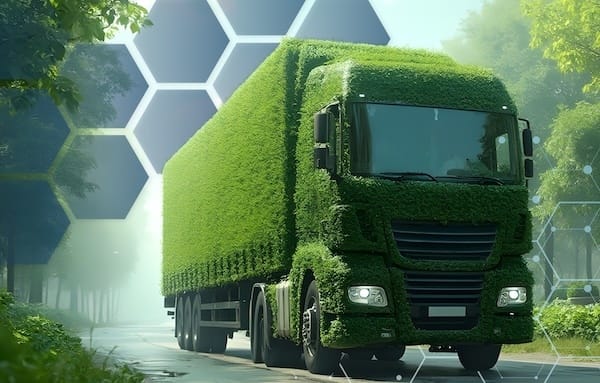
Amazon deployed BrainBox AI across three grocery fulfillment centers, reducing energy use nearly 15% through autonomous temperature control and ventilation adjustments. Following pilot results, Amazon plans rollout across 30 grocery fulfillment and distribution sites with store installations starting in 2026. The e-commerce giant targets carbon neutrality by 2040 but posted 6% year-over-year emissions increases in 2024 after a 3% reduction in 2023. Climate tech justifies itself through operational savings rather than environmental goals.
Linde Material Handling secured German federal funding for two 42-ton electric tractor units and ten light commercial vehicles under the KsNI guideline promoting alternative drive systems. The heavy trucks feature 600 kWh battery capacity with 500-kilometer range, projecting 180 tons of annual CO2 savings. Federal support through the German Recovery and Resilience Plan funded both vehicles and charging infrastructure. Linde targets 4.7% annual emission reductions through 2030, reaching net zero by 2050. Battery recycling partnership with Glencore processed 15.8 tons of lithium-ion modules in 2024. Policy support meets operational viability.
Warehouse Tech
AI learns picking patterns while RaaS models lower automation barriers

MIT-founded Pickle Robot Company deployed one-armed robots that autonomously unload trucks, handling boxes up to 50 pounds at rates of 400 to 1,500 cases per hour. Customers including UPS, Ryobi Tools, and Yusen Logistics use the systems combining generative AI with machine-vision software. The company employs 130 people in Charlestown, Massachusetts, ramping production this summer with two-armed robots planned afterward. Warehouse injury rates run over twice the national average. Retention through automation.
Neural networks now predict warehouse pick times by learning from real movement data instead of relying on fixed averages, factoring in item size, storage location, worker experience, time of day, and shift congestion. The systems learn workers avoid certain aisles during peak hours or that zigzagging wastes more time than sequential picking. The technology generates paths based on what worked before, mimicking best pickers' instincts and making them available to the entire team. Pattern recognition over calculation.
95% of U.S. industrial businesses plan new automation within three years, according to RobCo's survey of 400 business leaders. Only one-third currently use robots, but 54% are testing or planning deployments. Companies already using automation report 53% increased productivity, 52% time savings, and 50% resource efficiency improvements. But 48% cite high initial investment as the primary barrier. Robot-as-a-Service models bundle maintenance, integration, and software updates into predictable monthly fees. Deloitte projects 3.8 million industrial jobs needed but warns of a 1.9 million worker shortfall. The barrier? Capital costs. The solution: monthly payments turn CapEx into OpEx.
Warehouse Quick Deliveries
AI planning to merger delays
VW opened Venice port operations shifting export flows from northern Europe toward southern routes closer to Eastern Mediterranean and Asian markets
Cybersecurity elevated to executive strategy as companies treat cyber risk as operational metric amid ransomware attacks targeting ports and terminals
Slync.io founder's 20-year sentence upheld by appeals court on wire fraud convictions for diverting $7.2 million in investor funds
Temu suspended China-to-U.S. shipments after tariffs hit 145% and de minimis rule expired, shifting to U.S. warehouse fulfillment only
"In an economically challenging environment in particular, it is especially important to combine improvements in efficiency and cost-effectiveness with sustainability benefits. We have consistently refined our product development strategy by integrating sustainability aspects into the initial design phase, as well as into the production process."